Inner Writing
i eat the stars – Sarah Wilson
I think this book has changed my life.
There has been a watershed, a turning point from which there may be no return. Certainly it has opened my mind to other ideas and perspectives, the implications of which I don’t yet know. I wonder how this book can so radically and powerfully move and shift me and yet also frustrate and annoy me. I better explain because I’m thinking you ought, at least, to be aware of this book and the perspectives it offers, if you are not already so.
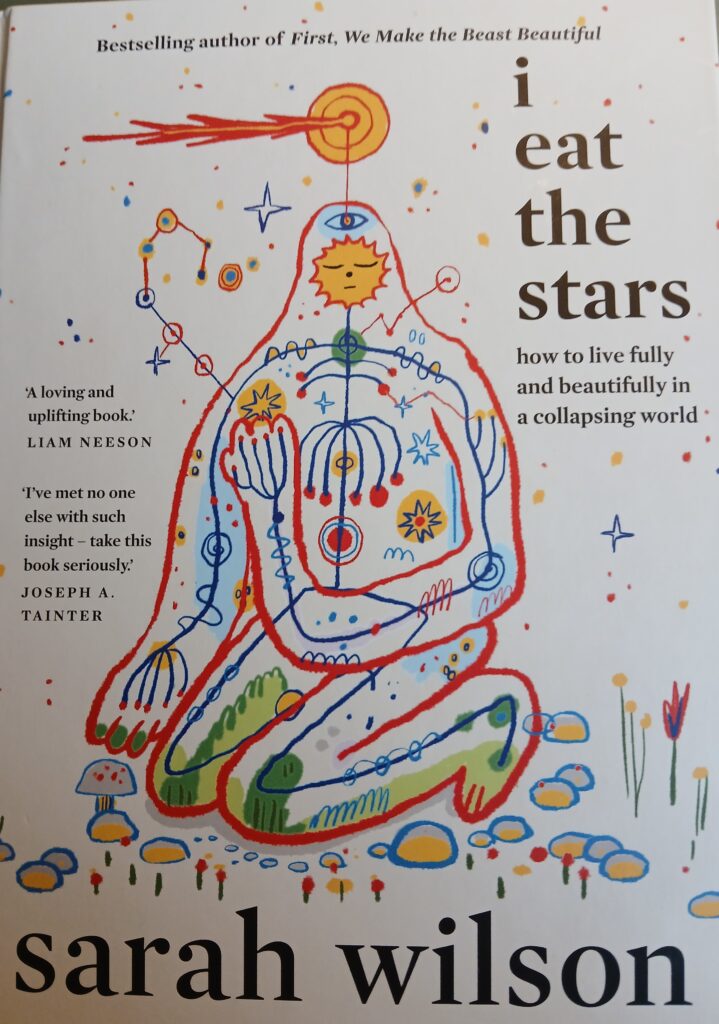
Sarah Wilson is an Australian Journalist living in Paris. She has written a number of other books which I have not read. She has all the credentials as a top flight climate activist and, what is very clear, she has conducted a shed load of research over some years for this book.
Her thesis is that the world is in total collapse. The ice caps are melting, the Amazon disappearing, the oceans getting hotter, there is no appetite for Net Zero and the ecosystem and climate just cannot recovery.
But Sarah Wilson does not stop there. She says there is also political collapse with the breakdown of democracy and the rise of the far right. There is severe financial, energy, food, AI and demographic vulnerabilities, the world is definitely collapsing. Obviously she presents evidence and more detail for all of these assertions.
Let me be clear – she is not a climate change denier. There are the American billionaire boys and Reform Politicians who also say the world is collapsing. But that is so they can drill oil and drive their cars and anyway they all have their bunkers in New Zealand. No, Sarah Wilson is a woman who loves the earth and is mourning its demise.
So her shocking message is that there is no hope. No hope of the earth recovering – it is too late and it is already happening. Now that sent me into a week long depression. But deep down I knew she was right.
The Plan
Once we have come to terms with the fact there is no hope, Sarah says, we can start to live positively and gently in the world. She has so many important things to say here, reflecting on the spiritual and moral task of simplifying life, rejecting economic growth, embracing death and doing one’s duty to the earth and neighbours. A theme which runs through the book is how we must support the marginalised and vulnerable as the earth collapses. There is also practical stuff like learning analogue skills, sending your kids to scouts, growing stuff etc. She rejects the idea of stockpiling food and water, rather, we must start working with our neighbours and investing in the arts and culture – we should become ‘warriors of the human spirit’!
There is a lot of useful things to read here. I hadn’t realised that Collapse Theory was ‘a thing’ with research papers and the like. I didn’t know about Metamodernity and how it speaks into global collapse (which I will write about sometime). All of this is interesting and useful. But I do have a worry about this book and a complaint.
My Concerns
The worry is Sarah might be far too optimistic. What about the population of Bangladesh as the sea finally takes their land? Many of the Eastern islands of the Philippine will become inhabitable because of typhoons. Already many of their farmers are giving up planting rice and leaving the land. Where will they go? Who will welcome the many millions of migrants fleeing water starvation? Millions and millions of people will die over the next forty years. James Lovelock predicted all this. Before he died he said it is too late and we need to build nuclear power stations and tall strong boarders to keep people out.
How will our society and local community respond to the hardships? Sarah exhorts us to cooperate with our neighbours, learn new skills, grow beans and do yoga on the lawn, (no she didn’t mention the yoga). There is nothing wrong with any of this but it all reads so……….. ‘Dulwich’. Yes we were kind to each other and we did shopping for each other during Covid 2020 and we met up socially distanced. But I also remember how quickly the shops emptied how some stockpiled while others went without. Crisis brings out the best and worst of us. Migrants living on marginalised housing estate regularly receive violence from locals. Civil disorder is not far below the surface, ask the Black kids around Camberwell, ask the Met Police Chief who said as much on live TV last week. Maybe that is why the state enshrined so quickly anti-protest legislation and installed facial recognition even in Sainsbury’s. Will this set the tone for global collapse?
My complaint with this book is small really compared with the topic. The book often reads like Sarah Wilson’s journal. I got a bit annoyed with all the times she told us about her tears, her cafe meetings in Paris, her running in the forest (often with more tears) and the meeting with famous scientists, names dropped everywhere. Much of it felt like virtue signalling. There was far too much of ‘her’.
But then this is an important book and I am glad to have read it. It has changed me and the way I look at the world and faith. I suspect there is another blog to be written about how my faith needs to re-adjust, especially if Jesus is not going to rock-up at the end and make it all better.
Please do comment below. Tell me how wrong all this is. Tell me Jesus is going to ‘rock up’ at the end.
If you think this stuff has value and you want to express that you can buy me a coffee.



You’re about the tenth person (I exaggerate!) to have mentioned this book. No, I haven’t read it yet. That’s a pretty good summary you’ve given us! Do I still need to read it, I wonder. But I can see how reading it might turn one around. I’d also point you towards a rather wonderful interview with Mary Beard (now on Youtube), with the delightful Paddy O’Connell on BBC2’s Newsnight back in July. Just to give a bit of perspective as to where we are in the greater scheme of things and long perspective of history.
Thanks Carole, I will look up the Newsnight clip. You could borrow my copy but I have already promised it to a number of people already.
Brother,
I’ve just read your review of I Eat the Stars. It looks like the book has made a big impression on you.
When you first showed it to me, I went to check her out online. I listened to a couple of podcast interviews and read a bit about the book. My first impression of her—probably distorted by the media—was: “Okay, here we go, another glamorous celebrity writing a kind of California-style self help book, something a Hollywood activist like Gwyneth Paltrow might write.”
I’m sorry to say this, but she didn’t come across (at least in those interviews) as a serious, rigorous thinker of substance, with a deep sense of spiritual transcendence—maybe she is—but more as a writer of “what is trending.” I know I’m very prejudiced about middle class voices—white, Black, red, or blue—offering us their wisdom from the comfort of their nice lives (nothing wrong with that in itself) for nice people who live inside the reality of their own worldview.
I wonder what the working class would make of her work. Or the vulnerable you mention: people on the move, rootless, wanderers like me. I long for someone who can bring the rich spiritual tradition that actually challenges us to live in the real world of every day—bills unpaid, cost of living, car broken, house without heating, unemployment—not in an eschatological Narnia.
Let’s talk more about this. I’d really like to hear more about the parts of the book that went deep for you.
E
Dear Ernesto,
Say it like a prophet dear man. Yes the book did make an impression because of the new and shocking perspectives it bought me. I have also seen some podcasts. One was an Australian news team interviewing her with an audience who seemed to belly laugh every time someone spoke. So poor Sarah was trying to explain about collapse and everyone was laughing as if they really hadn’t heard what she said. Anyway.
I think what she has done has presented the issues of climate and world collapse in a way which can be accessed by a wider public. She is not an academic although the book is very well researched over at least 3 years. I got the impression she was totally 100% committed to this so it was not a ‘flash in the pan’ as my mother would say. Also throughout she does call attention to those who are already and who will be left out, marginalised in the collapse saying we need to find a way of them being included. Your right she is from the middle class professional classes. As I said I got really tired of all the running and cafe references and her responses to collapse is very idealistic. There needs to be more reflection on the responses to collapse which is robust and maybe realistic. As I said – it would not take too much for their to be chaos on our streets.
I hope I didn’t give the impression she wrote from a faith perspective – she most certainly doesn’t. That work needs to be done and you and the people who have written to me today can begin to think and write. I will certainly write more about this and I am hoping some of the readers will write something and I host it.
I think I am emerging from a period where I have been considering my own death – although I might still be in that. When death is tomorrow then today is precious – of course we know that. There is a grief held by the person who is dying and now I find a grief for the world which is dying. We have not talked about Gia – which will live on. Maybe it is just this society, the trappings which will die and needs to die. Whoever is reading this – let us continue to talk, share, think be in communion, hope.
tim
Hi Tim
This is Matt, who used to be from number 79! Thanks for this review, I’d never heard of this book. I hope you are okay after the book made you feel depressed. It’s hard isn’t it. It reminded me of a book called Life After Doom by Brian McLaren, a Christian writer who is part of Richard Rohr’s Centre of Action and Contemplation. I haven’t read the book but I did hear this interview with him about it on the Mid Faith Crisis podcast, which they re-released a few weeks ago: Episode 380a : A Summer Repeat with Brian McLaren (I tried to include a link but it didn’t work – if you google ‘Mid Faith Crisis podcast’ you can find the episode on their website). I’ve just listened to it again. He also faces the problems head on but from the sounds of the interview and from what you say in your review, maybe his responses are a bit more grounded? But not without hope. I don’t know if I will read ‘I Eat the Stars’ but now I am thinking of getting the Brian McLaren one!
Matt
Greetings Matt,
SO lovely to hear from you. Trust you and Jat are well. You have been up in Cambridge for quite a few years now. Are you still writing?
Thanks for your comment. Thanks so much for the recommendation of Brian’s book and the podcast. I have had a number of responses this afternoon (some of whom have not yet posted a comment on here yet) – but I think there will be a number of us who will look Brian up. I remember when he was very much post-evangelical. Now very much in the CAC camp with Richard gives him a lot of kudos. If you write a review of that podcast and your happy to do so let me have a copy I would be most happy to host it here so the other folks can have access as well. I do wonder if Sarah Wilson’s book is for you – I think she has done the important job of highlighting the Collapse issues for people like me who had never heard of it but who had those secret thoughts. It is rather a ‘popular’ approach.
So thanks Matt – lets keep in touch -I will continue to write about this and how ‘faith’ squeezes into all of this.
Hi Tim,
Yes, the science cannot be ignored but the prognosis is not certain and there is a limit to what we as individuals can do beyond following the wisdom of the Christian message to “Live simply and do not lose hope.” Rather than buying books like this , I suggest donating to a charity like World Land Trust who wisely identified long ago that ownership of rain-forest land is a powerful way of protecting it. Anyway, to cheer you up I’ve bought you a cup of coffee through your website!
Hi Nick
thanks for the coffee. And thanks for your perspective. I usually do resist a book which has in its title “how to…….” I noticed that Sarah Wilson’s book had “How to….” in the sub title after I bought it. But I am grateful I read this book. It has given me so much to ponder over. She writes convincingly that the science is pretty clear that collapse is inevitable. But your right it would be most profitable now to think what Christian wisdom and tradition has to tell us.
tim
I’m unsurprised you described the book as being ‘Dulwich’; to judge a book by its cover, if I can’t walk into a certain bookshop in Camberwell to buy a copy, it can only be because it sold out.
I also struggle with this deep despair inherent to a collapsing system. To reinstate your hope, I suggest you read ‘How the Irish saved civilisation’. It’s a fantastic book about the de-romanised Christianity of St Patrick and the Irish, discussing what comes after the collapse. Certainly, the missions of the Green and White martyrs offer a far more compelling blueprint, dare I say Icon, for the hope and faith, and where that hope will emerge from, after collapse than the yummy middle-class yoga on the grass. If one recalls quite how the Irish have been treated by the West (especially the UK) there is a sense in which the book addresses your concerns for the marginalised.
You may find, as I did, that the de-romanisation is perhaps deeply important for understanding how faith needs to change. Indeed, one has to reckon with the parts of our faith, and theology, that reinforce the empire of the day. One such criticism that holds particular relevance to this discussion comes from the East who, to simplify (and possibly misunderstand) a deep theological argument, would say that Romish / Western understanding of hell reflects the Roman imperial attitude to crime and punishment, rather than our sin itself preventing communion, theosis, with the divine. This argument extends further to the Reform tradition: in rejecting the Bishop of Rome as supreme pontiff, their understanding of redemption in Christ became increasingly legalistic and violent, in an act of supreme irony, Roman (in the imperial sense). Certainly, I don’t find the model of penal substitutionary atonement compelling now, nor would I imagine the slaves of old either. Does it really provide the hope we need in a dying order? The Christianity of the second and third centuries offered hope to the hopeless, and empowered them to do great things, even if this type greatness does not fit our modern notions of achievement. Our faith seems to be at its best when on the back foot, with a theology to match. As you mentioned over email, we all have much to learn from the desert fathers and mothers.
To reflect further on the Green and White Martyrs, part of what makes their actions so compelling as a model of hope is the recognition, and perhaps irony, of the martyrs work being that which laid the foundation for our current lives and present collapse. Vanity of Vanities. I think it is important to recognise the ebb and flow of life on all scales, the personal, local, national and global. To cope with it, we need to find the beauty in knowing maybe that which comes after can be better. If you are in the mood for some (science) fiction `A Canticle for Leibowitz’ really explores the cyclic nature of collapse and recovery, with the last chapter really throwing that which we hold dear in our faces.
I’ll see if I can find time to read ‘i eat the stars’, and maybe we can discuss further. Next on my reading list is Lenora Ash’s ‘remember we’re here forever’, which from the reviews and discussion online seems to be an incredibly hope filled book. I’ve certainly enjoyed her articles in the guardian and FT. How very Dulwich.
Hi J.
it was kind of you to take time to respond at length and in such depth. I have ordered “How the Irish saved civilisation”. I need to find out more about the Green and White Martyrs – I thought one was about penance and the other about missionary work – so I really need to read that book. But I do think you are onto something with the martyrdom theme. Will hold on the “Candle of Leibowitz” it does look an interesting book but I’ve too much on. (You are very well read). I would go straight to the Lenora Ash book. Isn’t that about the increased interest in GenZ spirituality? I think you could get along nicely without reading Sarah Wilson.
I thought you might have something to say about Metamodern. Perhaps for another time and place. Thanks again
T
Hello
I got pulled into the ‘Sarah Wilson cult’ in 2020. I read her book ‘This one wild and precious life’, which absolutely sucked me in. After reading this, I became extremely anxious about the environment, climate change, AI, and the list goes on. I subscribed and paid for Sarah Wilson’s Substack, which I realised that she would be making roughly a minimum of $11million AUD a year (however, she states she “doesn’t buy things…?!”). I started listening to all of her podcasts, and following all of her work. Then Sarah Wilson started talking about a collapsing society, and this really ramped up my anxiety. All of the things Sarah was saying were so negative and scary. In the meantime, in real life, I was becoming so anxious because of Sarah Wilson’s viewpoints. I started arguing with people in real life about the climate, and isolating myself as I felt like there was no future for me or my children. Very doom and gloom. Then approximately 12 months ago, it just hit me that Sarah Wilson was like a cult leader. It was like I just woke up to her bullshit! Now I can see that Sarah’s messaging is very dangerous and extreme. And she has many followers who believe every word she says. There is a great article written by ex Extinction Rebellion spokesperson and member, Zion Lights, titled “Climate activism has a cult problem”. This really helped ease my anxiety and pulled me out of this extreme cult-like way of thinking.
Thank you Sarah for your comments. I only came across Sarah Wilson with this book. I’m grateful for having read at least the first part of the book. It seemed to confirm everything I read in the news that actually the world is in collapse. But I became tired of the second part of the book. There seemed to be a disjointedness between the first part of the book and the second. And the journaling style resulted in ‘her’ what she was thinking and doing seemed to get in the way. It seemed all about her.
Your idea of her being a cult figure is interesting. It is good you have found now some equanimity. Thanks for your post